
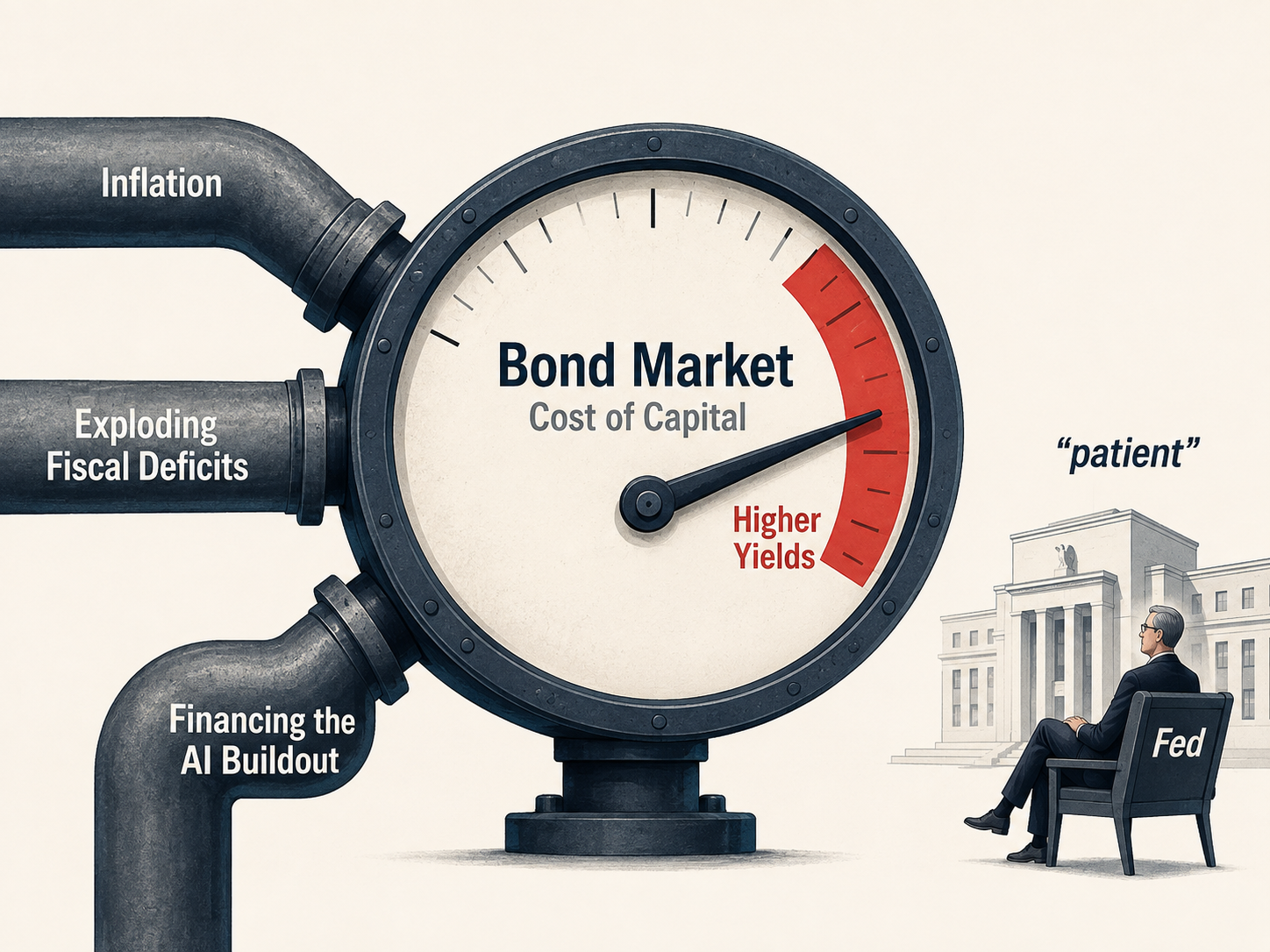
I’m not one to usually worry about government debt, but I believe we have a problem, folks. Inflation is elevated and AI needs a ton of capital to finance its buildout, both of which would normally raise the cost of capital, i.e. interest rates. But on top of that, we’re running unprecedented fiscal deficits. Via the US Treasury:
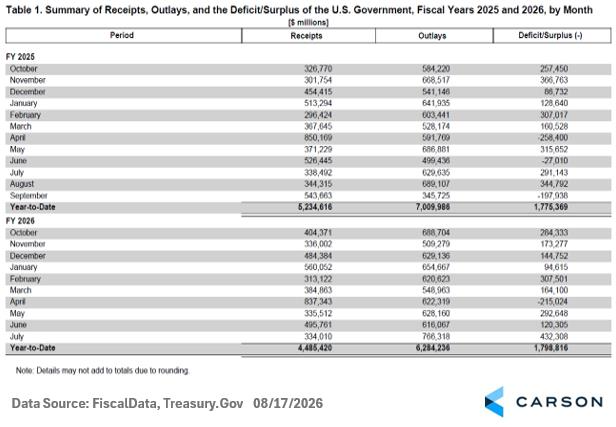
- In the 2025 fiscal year (October 2024–September 2025), the fiscal deficit clocked in at $1.78 trillion.
- In the first 10 months of the current fiscal year (October 2025—July 2026), the fiscal deficit has already larger at $1.8 trillion. We have two months to go.
The $432 billion July federal deficit was a record for the month and the largest monthly deficit since March 2021 ($660 billion amid pandemic relief). The only larger months were during COVID, when the government was spending heavily to prop up the economy:
- April 2020: $738 billion
- June 2020: $864 billion
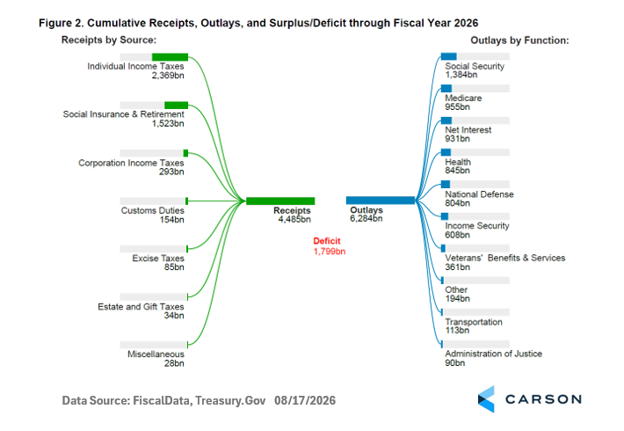
The chart below shows outlays and receipts. A few highlights:
- Corporate tax receipts have collapsed 24% relative to last year (due to a larger deduction).
- However, outlays continue to grow—and its mostly non-discretionary: Social Security, healthcare (Medicare, Medicaid), plus defense.
- Net interest spending at $931 billion is even larger than defense spending ($804 billion).
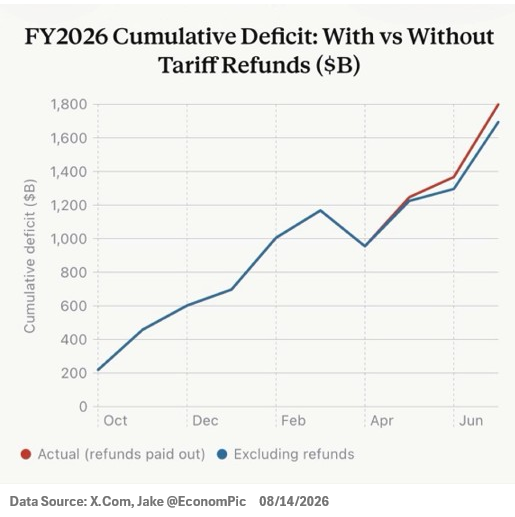
Tariff receipts are also falling due to refunds. July saw negative net customs receipts of ~ $9 billion. Tariff revenue is now expected to come in ~$250 billion below the Congressional Budget Office’s fiscal year 2026 projection. Tariff revenue is still 14% higher on a year-to-date basis from FY 2025 ($155 billion vs $136 billion last year), but stronger-than-expected income/payroll taxes offset about $75 billion of that.
However, the deficit would be large (~$1.75 trillion), even excluding the impact of tariff refunds, as the following chart illustrates.
Policymakers Have Lost the Plot, and the Bond Market
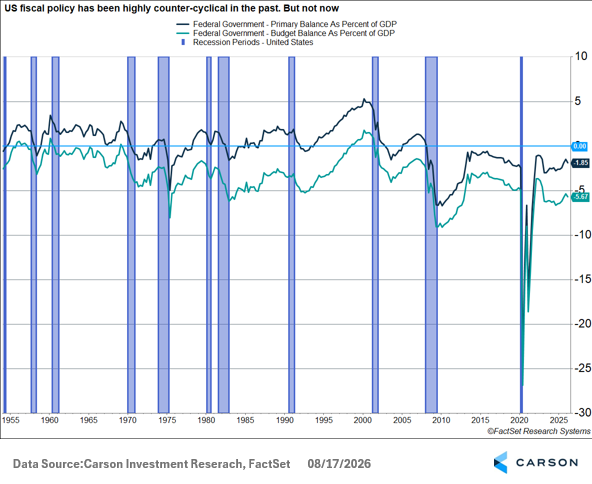
We typically expect the Federal Reserve to control inflation by raising rates. But that shouldn’t absolve the rest of Washington, D.C. These fiscal deficits are historically unprecedented.
The deficit is currently about 6% of GDP. The “primary balance,” which excludes interest payments, is around 2% of GDP. We’ve seen deficits this large over the last 70-plus years, but typically during recessions, when tax receipts fall and outlays rise through unemployment insurance and stimulus. During expansions, the opposite usually happens, which is why fiscal policy has historically been “counter-cyclical.”
What’s unprecedented is running enormous deficits this deep into an expansion—five-plus years after the 2020 COVID recession—and seeing them worsen. The only comparable episode was 2017–19, after the Tax Cuts and Jobs Act, but inflation was low then and tech companies were mostly returning capital to investors via buybacks.
Fiscal deficits typically contribute to corporate profits, including after the One Big Beautiful Bill Act passed last year. That’s obviously good for stocks.
So, is the piper getting paid? Darn right—via the bond market.
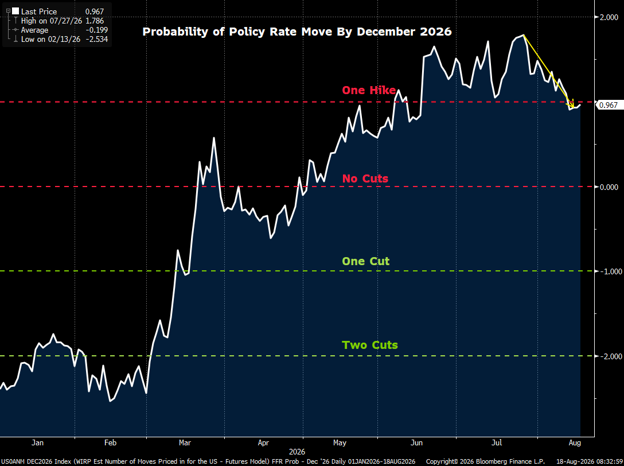
We’ve gotten a couple of benign inflation prints recently, after several hot months, and 2026 rate hike expectations have eased. The base case for September is a policy hold, with hike odds at 34%. For the rest of 2026, markets still price at least one hike at 97%, down from 180% before the Fed meeting (100% probability of one hike plus 80% for a second).
Source: Bloomberg Finance LP
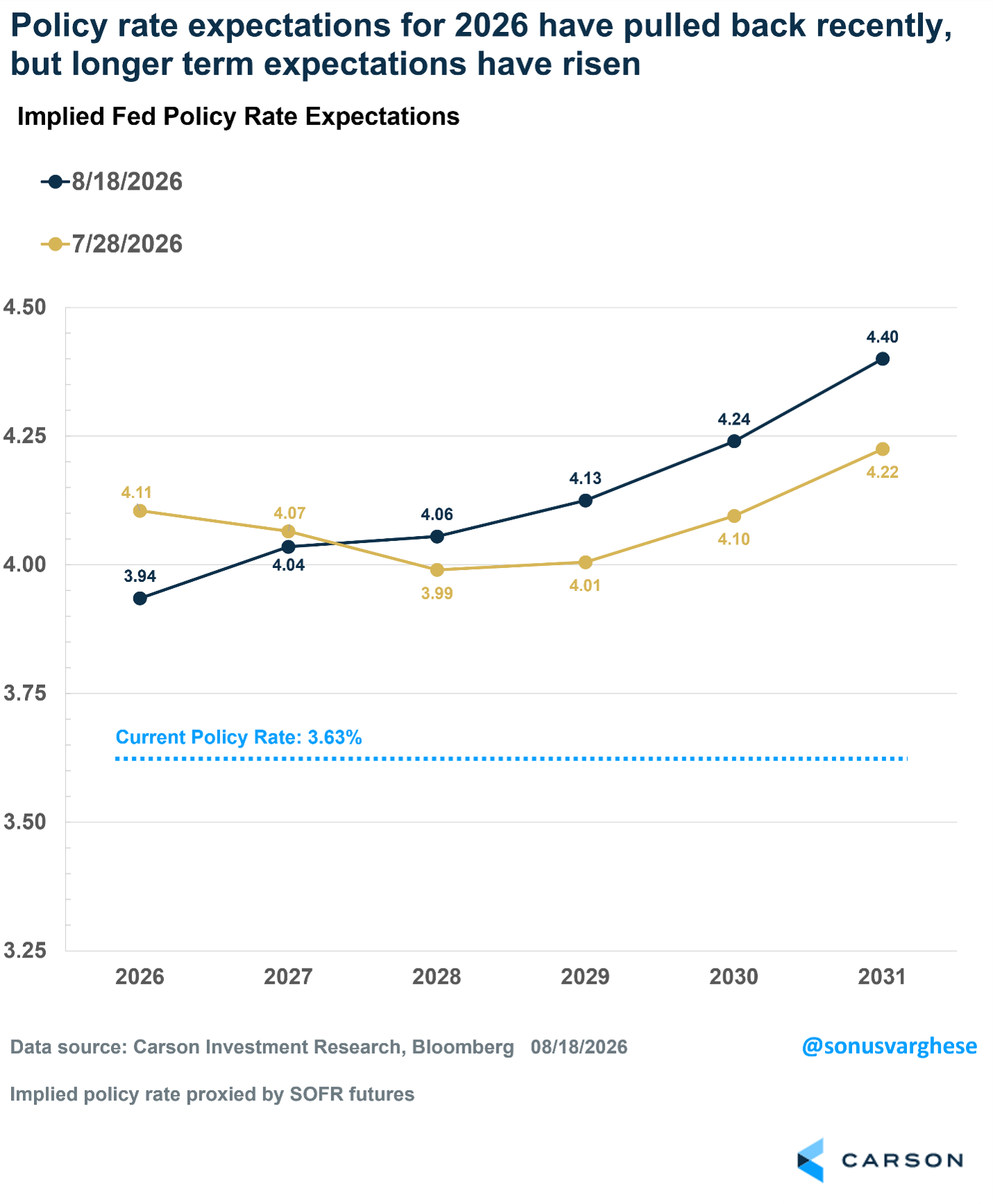
Here’s the thing, though. Markets seem to think the doves have the upper hand, but only temporarily. If policy stays unchanged while nominal GDP/inflation runs hot amid huge fiscal deficits and the AI buildout, the Fed may eventually have to be more restrictive. You can see this in the forward curve for short-term policy rates (using the secured overnight financing rate as a proxy):
- The 2026 policy rate expectation fell from 4.11% on July 28 (prior to the Fed meeting) to 3.94% on August 17 (with one rate hike taken out).
- The 2027 rate didn’t change much, easing from just 4.07% to 4.04%.
- However, as you move from 2028 to 2029 and beyond, you see policy rate expectations higher than before
Also note that policy rates across 2026 and beyond are still expected to be well above the current policy rate of 3.6%.
This is playing out across the yield curve in the government bond market as well:
- The 2-year yield has now eased from a peak 4.35% in late July to 4.17%, implying investors expect average policy rates over the next two years to average ~0.20%-points less.
- But the 10-year yield has stayed elevated and is now at 4.71%, which is the highest level since January 2025 (though at the time it was because real growth was expected to be closer to 3%).
Source: Bloomberg Finance LP
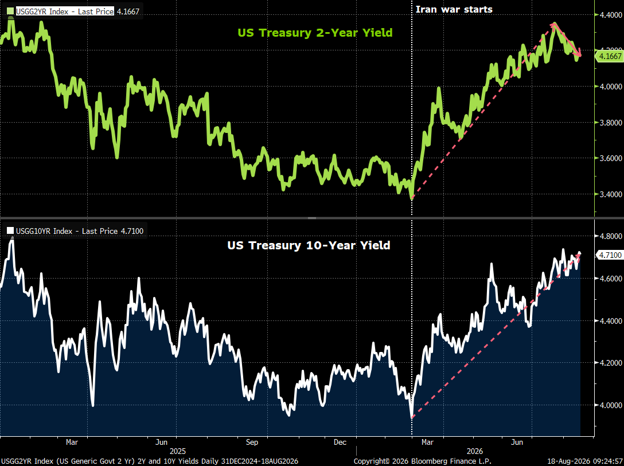
This is playing out across the yield curve in the government bond market, as well:
- The 2-year yield has now eased from a peak 4.35% in late July to 4.17%, implying investors expect average policy rates over the next two years to average ~0.20%-points less.
- But the 10-year yield has stayed elevated and is now at 4.71%, which is the highest level since January 2025 (though at the time it was because real growth was expected to be closer to 3%).
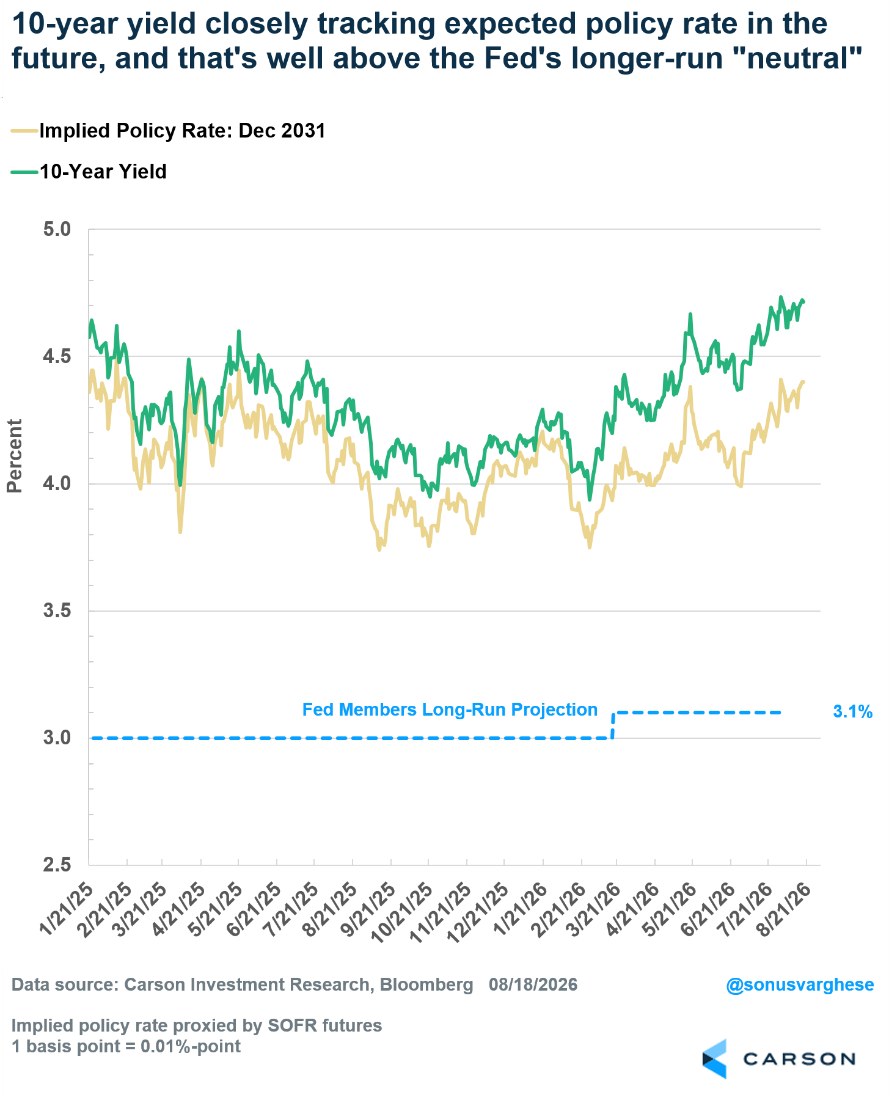
Longer-term yields have been grinding higher since the Iran war started, and there was no let up even when oil prices pulled back in June and July. Of course, oil prices have been rising again (a reminder that the Middle East crisis is far from over) and long-term yields along with it.
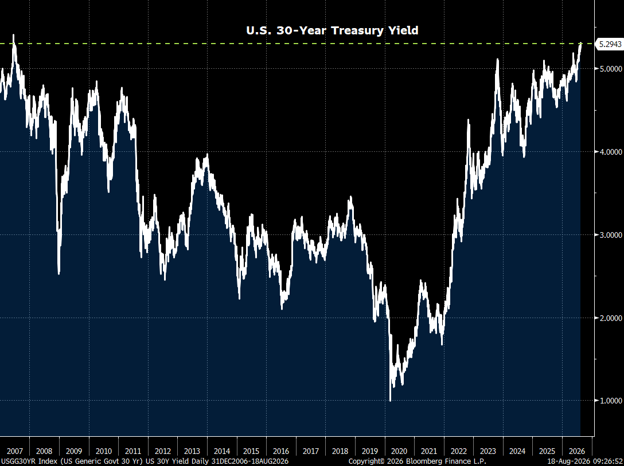
The 30-year yield is at 5.30%, which is close to the highest level we’ve seen since 2007 (the peak that year was 5.40). Last week, a $25 billion treasury auction of 30-year bonds drew yields as high as 5.22% (the previous month’s auction cleared at 5.06%). That’s the highest yield since 5.52% paid in August 2001 (30-year auctions were suspended for ~5 years after that). It was a “successful” auction, in that investors still wanted US Treasury debt. But they charged the government the highest price in 25 years for it.
Source: Bloomberg Finance LP
There’s a lot of competition for capital now, whether it’s from tech companies or the federal government. It’s easy to think that the AI buildout is “crowding out” government debt. But I think that’s backward. We’re five-plus years into an economic expansion and the federal government is running massive deficits, even as inflation remains well above the Fed’s target (while waiting for yet another “supply shock” to ease). Plus, AI needs ever more financing. Of course, the cost of capital is rising, and it shouldn’t be a surprise. To be clear, this has an adverse impact on other parts of the economy, notably housing.
Policymakers sitting back and letting inflation stay elevated (the Fed) and fiscal deficits explode (the White House and the Congress) while the bond market screams out in pain is, in my opinion, akin to Nero fiddling while Rome burned.
Sonu Varghese is a non-registered associate of Cetera Wealth Services LLC, Member FINRA/SIPC. The opinions contained in this material are those of the author, and not a recommendation or solicitation to buy or sell investment products. This information is from sources believed to be reliable, but Cetera Wealth Services, LLC cannot guarantee or represent that it is accurate or complete.
Any information provided by the author is provided entirely on behalf of CWM, LLC and is in no way related to Cetera Wealth Services LLC or its registered representatives.
The return and principal value of bonds fluctuate with changes in market conditions. If bonds are not held to maturity, they may be worth more or less than their original value.
9101172.1.-0926-C
